In the aftermath of the recent fraud involving Haryana government accounts, IDFC First Bank has reassured investors that the incident was isolated to a single Chandigarh branch and stemmed from employee collusion.
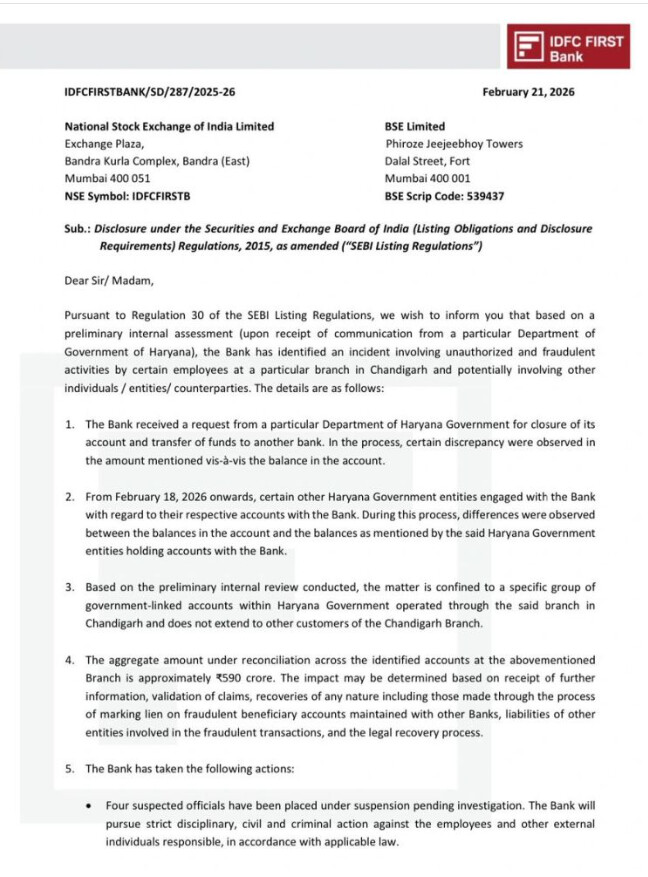
During a conference call, CEO V. Vaidyanathan clarified that the breach was physical and non-digital in nature, involving forged cheques and manual debit instructions — calling it “the oldest kind of fraud known to banking.” According to the bank, certain branch employees, allegedly in connivance with external parties, fraudulently transferred funds to accounts outside the bank.
 What Happened?
-
An initial discrepancy of ₹490 crore surfaced after a government fund transfer request.
-
Internal reviews later identified an additional ~₹100 crore exposure.
-
Four employees have been suspended.
-
Police complaints have been filed.
-
KPMG has been appointed to conduct an independent forensic audit.
-
Haryana government deposits account for just ~0.5% of the bank’s total deposits, limiting systemic impact.
Management emphasized that the bank remains financially strong, with improving operating profits, and stated that any financial hit will be absorbed through the P&L over time.
 Additional Context & Market Impact
Based on broader reporting and market reactions:
-
The incident triggered short-term volatility in the bank’s stock price, reflecting investor concerns around internal controls and governance.
-
Regulators are closely monitoring developments, given the involvement of government funds.
-
Analysts have noted that while the financial impact may be manageable relative to the bank’s balance sheet, the real risk lies in reputational damage and trust erosion.
-
The case highlights operational risk management gaps, particularly around manual processes in public sector-linked accounts.
 Bigger Picture: Lessons for the Banking Sector
This episode reinforces three critical realities:
-
Fraud risk is not always digital — legacy processes can be equally vulnerable.
-
Internal controls matter more than scale — even growing private banks must continuously tighten oversight.
-
Reputation capital is as important as financial capital — restoring trust is often harder than absorbing losses.
While the bank maintains that this is an isolated case, the coming weeks — especially findings from the forensic audit — will determine whether this remains a contained operational lapse or evolves into a broader governance discussion.